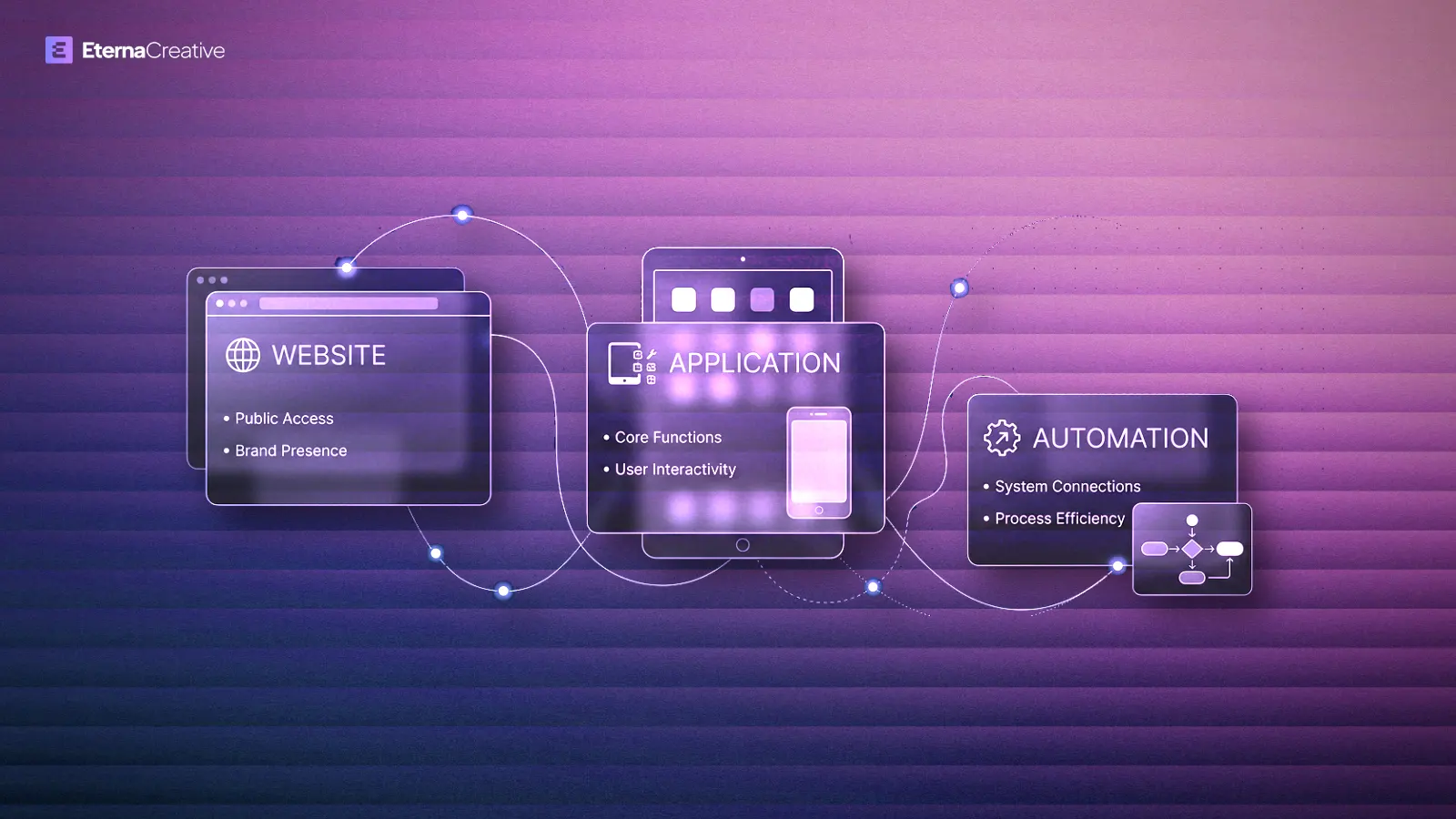
A website is for people who do not have an account yet. They need to understand the offer and take one action - book a call, join a waitlist, request a demo. An application is for people who log in and come back to do a job. Automation is not a product anyone logs into. It moves work between CRM, Slack, invoicing, and email. Pick the lightest job that unblocks revenue or hours this month.
TL;DR
- Website: a conversion front door. Demos, waitlists, bookings. Not a pamphlet that lists services and hopes.
- Application: people log in and do work - a product, a platform, or an internal tool. Owned by you.
- Automation: glue across tools you already pay for, with a human on approvals where money, legal, or customer comms is at stake.
- If you are unsure, start with the lightest job. Do not buy all three in one build.
What each one is for
A website informs, persuades, and converts. The visitor is not a user yet. The page has one job: get them to act.
A brochure site is a digital pamphlet: about, services, contact. A conversion site is built around a measurable action on every major page. You want the second one.
A web application is where the work lives: accounts, dashboards, records, tasks people return to complete. If they must come back tomorrow to get value, you are not shopping for a website.
Automation sits between tools you already pay for. Nobody "opens the automation." They open HubSpot or Slack and the handoff is already done - or sitting in an approval queue.
If nobody on your team can explain the offer in one sentence, you do not need an app yet. You need a page that makes the offer obvious. If customers already buy and then wait on a spreadsheet, you do not need a prettier homepage. You need accounts and workflows. If the same email dies in a thread every Friday, you do not need AI. You need that handoff to stop living in inboxes.
Mixing the three jobs in one build is how projects balloon. Pick the job that is on fire first.
Website vs application vs automation
Starting bands below are Eterna's. Agency-market ranges in 2026 sit much higher in US/UK quotes - treat those as order of magnitude, not the invoice. Time for a focused first version is still weeks, not a quarter, when you pick one job.
| Website | Application | Automation | |
|---|---|---|---|
| Primary job | Convert attention | Deliver ongoing value in-product | Remove repetitive handoffs |
| Typical user | Visitor / lead | Customer / team member | Ops / sales / delivery team |
| Auth | Optional (forms, booking) | Core | Tool accounts + approvals |
| Starting bands | Landing from €800; marketing from €2.000 | MVP from €4.000 | Single workflow from €500 |
| Time shape | Days to a few weeks | Often 4-6 weeks for a focused first version | Days to about two weeks for a first live workflow |
| Market quotes (2026 estimate) | Landing roughly $1,500-$6,000 studio; marketing site $5,000-$25,000 | Custom MVP often quoted $20,000-$150,000+ | Starter workflow $1,000-$3,500; production single workflow $5,000-$15,000 |
Full detail: Website, Application, Automation. Rough bands before you over-scope: the cost calculator for apps, automations, and websites.
Choose a website if
The primary action is a form, a call, a booking, a waitlist, or a demo request. You do not need accounts. You need a front door that does the sales conversation.
- You need demos, waitlists, course signups, or bookings
- The offer is still fuzzy and the site has to make it obvious
- The product can wait until the funnel proves people actually want it
- You have been running on a brochure site that does not bring in clients
Think of a consultant whose calendar is empty even though referrals are warm. The problem is not a missing login. The problem is a page that never asks for the booking. Same for a founder collecting emails before the product exists. Same for a practice that still sends a PDF after someone finds them on Google.
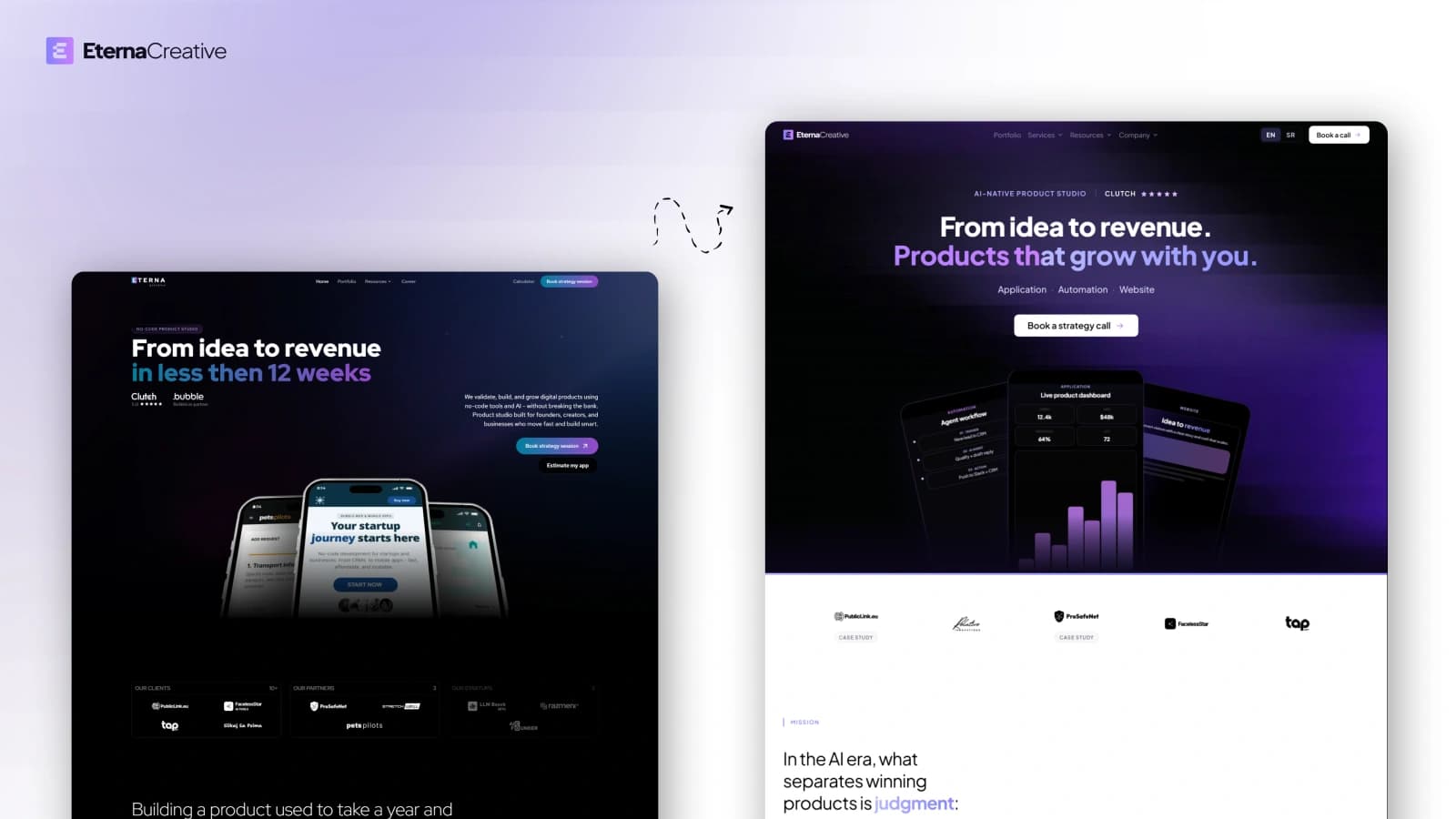
We rebuilt our own site from Bubble to Next.js in four weeks. The bottleneck was identity and conversion - not a missing members area. That story is the Bubble to Next.js rebuild. A website can still be a product problem. It is not automatically an application.
Choose an application if
People must log in, manage data, complete workflows, or replace a spreadsheet that has become the company. A website will not deliver that. You are past "explain the offer" and into repeated use.
- Users need accounts, roles, dashboards, or workflows
- Spreadsheet plus inbox is already the product, and it is breaking
- You want an owned product, not a rented no-code ceiling
A booking page is a website. A client portal where they upload files, see status, and come back next week is an application. Inventory that used to live in a sheet your warehouse lead updates by hand is an application - or automation sitting on top of tools you already have, if nobody needs a new login.
ProSafeNet is the application job: safety professionals log in. The founder's numbers we stand behind are 1000 users in the first three months, 20% conversion, two official sponsors inside two months (Dr. Vladimir Cvetkovic). That is not a brochure with a members plugin. It is a product people return to.
PublicLink started as a public-sector network and became procurement tooling: matching, CV intake, anonymous Reopening of Competition bidding. 150+ professionals in 60 days, then 1.6k+ match records, three roles in the product. A marketing site could have launched the network. It could not run the competitions.
Choose automation if
The value is moving data between tools you already pay for. There is no new customer-facing product. CRM intake, invoice handoffs, notifications, a queue with a human on approvals. One or two workflows that return hours beat a full "AI stack."
- The business already runs - the bottleneck is copy-paste, follow-ups, and status chasing
- You need CRM, email, sheets, and tools connected with logging and approval
- You do not need a new product yet. You need hours back.
HubSpot to Slack for a simple new-deal ping is often the native integration. That connector is not a project. Custom routing, logging, and approval on top of it can be. Do not buy "AI automation" to replace a checkbox in HubSpot.
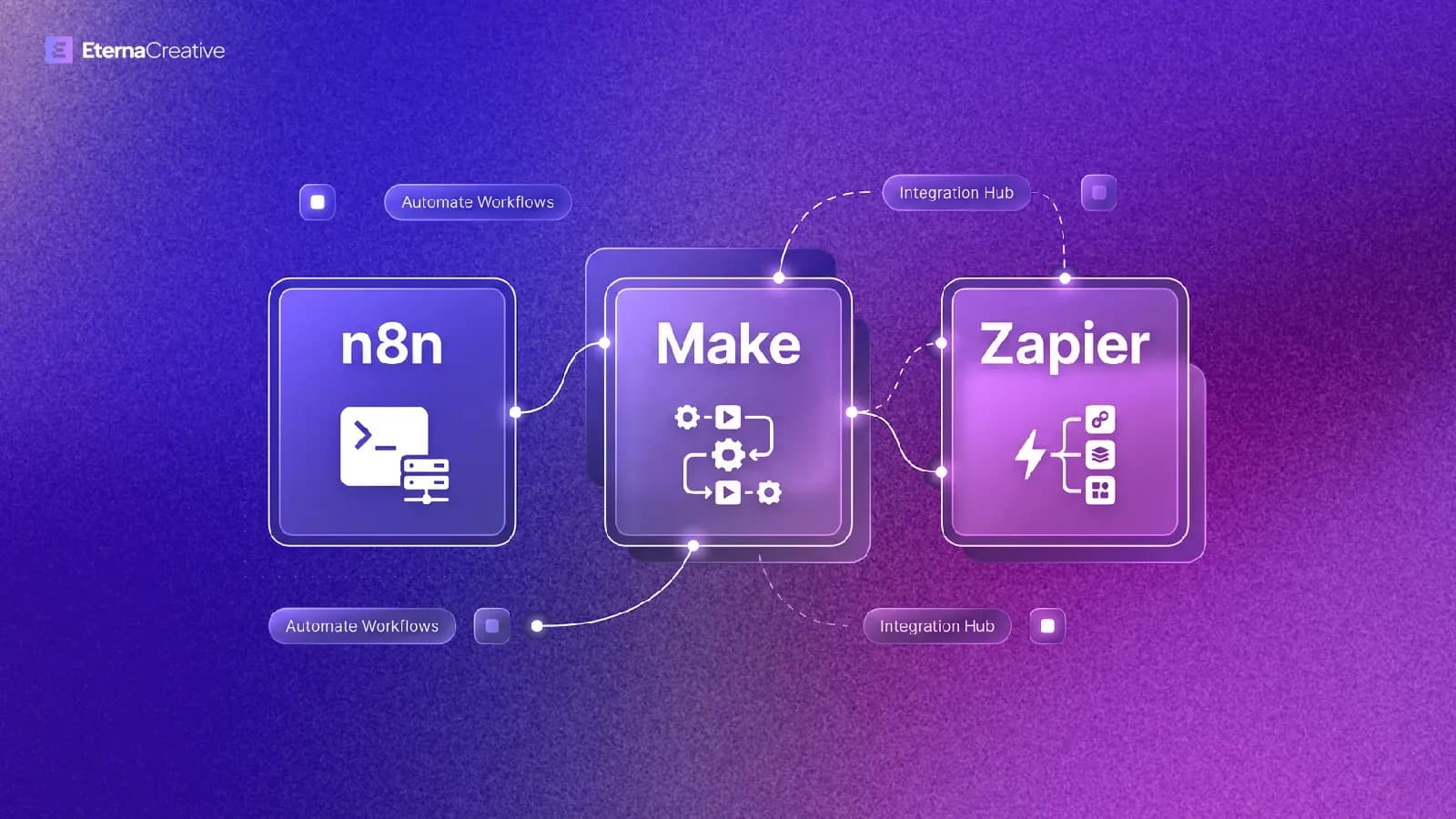
Stack choice inside this job: n8n vs Make vs Zapier for business ops. If the loop later becomes the product - operators living in it all day, volume that makes Cloud execution count the bill - that is when it should move into an application. Most first workflows never get there.
When you need more than one
You might need two jobs over a year. You rarely need all three this month. Sequences that actually hold:
- Website funnel first, application once demand is real
- Application plus automation for onboarding emails, CRM sync, and ops alerts
- Automation first for an SMB, website later when the offer needs a sharper front door
- n8n until the canvas is the bottleneck, then a custom application - the Zonik path, covered in the n8n comparison
Keep them as separate deliverables so none becomes a frankenstein. The calculator is one tool with three jobs for a reason. It will not tell you to buy all three this month.
Mistakes that waste the first month
Paying for an app when a conversion site would do. If the only job is book a call, join a waitlist, or understand the offer, an application is theatre. You will pay application money for a form.
Paying for a site when people need accounts. A pretty front door with no login does not replace the spreadsheet. If they must come back tomorrow to get value, you need an application - or you are lying to yourself with a members plugin.
Buying AI when HubSpot to Slack would do. Native connectors and a starter workflow beat a chatbot that restates the inbox. If the lightest version is a Zap you could have built this afternoon, that is the honest start. A toy you cannot explain is worse than nothing.
An app to hide busywork. If the pain is copy-paste across SaaS you already pay for, automation plus notifications plus a sheet or a BI view is enough. A dashboard nobody logs into is not a product. Inventory that used to take a full pass can move at least 50% faster when the handoff is a system (Tap Group) - that is an ops outcome, not a reason to invent a social network.
How to decide
- What must someone do in the first session?
- Do they need to come back tomorrow to get value?
- Is the bottleneck attention, product, or busywork?
Attention = website. Come back tomorrow = application. Busywork between tools = automation. If two answers fire, you still pick one to ship first. Mixing all three in one build is how a €500 workflow becomes a €15.000 platform nobody asked to log into.
FAQ
What is the difference between a website, an application, and automation? A website converts attention. An application is where people log in and do the work. Automation removes handoffs between tools you already use. They are three jobs, not three names for the same build.
Do I need a website or an app? If visitors need to book, waitlist, or understand the offer, start with a conversion website - not a brochure. If they need accounts and to come back tomorrow, you need an application.
When is automation enough? When the offer already works and the pain is copy-paste between HubSpot, Slack, CRM, or invoices. Do not buy an app to hide an inbox problem. Do not buy AI to replace a native Slack alert.
Why are starting prices below the US studio quotes I see? Those quotes are 2026 market estimates, not Eterna's bands. Published starting points: website landing from €800, marketing from €2.000, application from €4.000, a first workflow from €500. Exact scope lands on the call. Larger applications get a free Blueprint before build commitment.
Unsure? That is what the free strategy call is for - and the cost calculator for apps, automations, and websites for rough bands before you over-scope. Book a free strategy call if you want a pick without buying all three.