Client files should not go into a personal ChatGPT or Claude account. Before a firm uses AI on confidential material, it should approve the exact tool, account, data flow, retention terms, access controls, and review process, and check whether an informed client would reasonably object.
This is not legal advice. It is a checklist for the conversation with your partners, your bar or chamber, and your counsel, and which tool passes depends on 8 answers and your profession's rules. The methodology page explains how Eterna builds with AI.
What should you ask before client data goes into any AI tool?
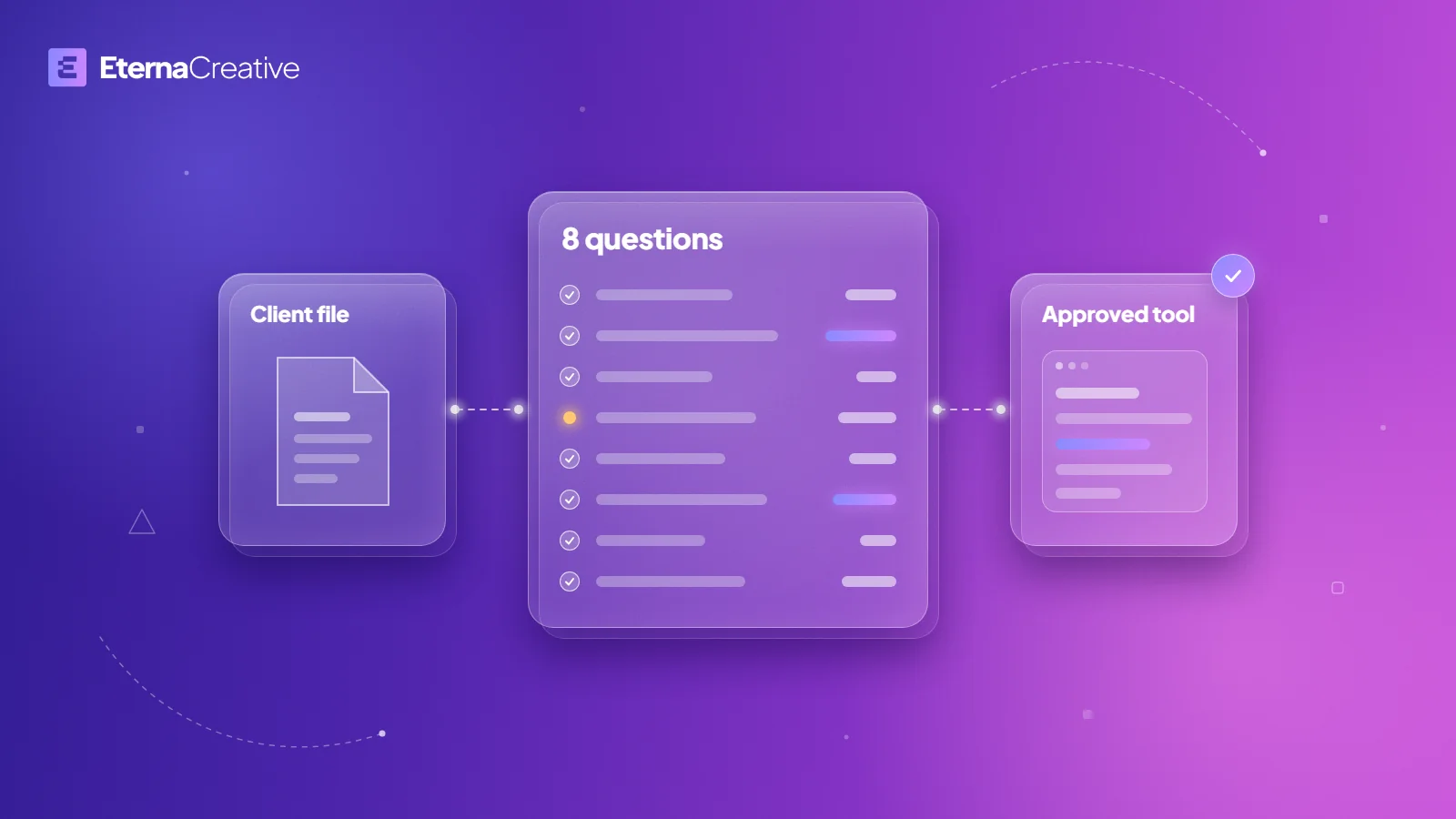
Ask these 8 questions about every tool, in writing, and keep the answers.
| # | Ask | Why it matters | Where it comes from |
|---|---|---|---|
| 1 | Does the provider train on what you enter? | Data you enter may be stored and reused by the provider unless the terms say otherwise (guide of the Council of Bars and Law Societies of Europe, CCBE, 2025) | CCBE technical guide, 2026; Accountancy Europe, 2026; the provider's own terms |
| 2 | Who at the provider can see it? | Staff access is a separate risk from training | CCBE technical guide, 2026 |
| 3 | Can third parties or authorities reach it, and would you be told? | Disclosure to others is a confidentiality question | CCBE technical guide, 2026 |
| 4 | How long is it kept, and does deletion reach the backups? | "Deleted" and "gone" are different things | CCBE technical guide, 2026 |
| 5 | Does the data leave the EU or EEA, and which model sits behind the tool? | The Slovenian Information Commissioner's opinion (non-binding, for a state body) says a transfer to a third country needs a separate legal basis | Slovenian Information Commissioner, 2026 |
| 6 | Which account type is it, and who controls the settings? | A setting each person controls is not a firm policy | OpenAI Help Center and Anthropic Privacy Center, read November 5, 2026 |
| 7 | What contract covers it? | The CCBE guide gives as examples confidentiality or zero-retention terms and a data protection agreement (DPA) that limits use to your purposes | CCBE guide, 2025 |
| 8 | What does a person still review and approve? | The tool prepares, and a lawyer or accountant decides | Our design principle |
Why is a personal ChatGPT or Claude account the wrong place?
A personal account puts the training decision in each person's hands, not the firm's. On an individual plan the user chooses whether chats help train the model, with a few exceptions, and the firm has no way to enforce that choice across staff.
Vendors change these terms. This is what their pages said on November 5, 2026:
| Plan | Used to train the model? | Source |
|---|---|---|
| ChatGPT Free, Plus, and Pro | May be, unless the user turns it off in settings. A thumbs up or down can make the whole conversation usable even after the user opts out | OpenAI Help Center |
| ChatGPT Business, Enterprise, and Edu, and the API | Not by default | OpenAI Help Center; OpenAI enterprise privacy page, updated January 8, 2026 |
| Claude Free, Pro, and Max | If the user allows it, if a chat is flagged for safety review, or if the user joins a testing program | Anthropic Privacy Center, March 16, 2026 |
| Claude for Work and the API | Not by default | Anthropic Privacy Center, August 19, 2026 |
Anthropic's Privacy Center (August 19, 2026) says that on Claude for Work, a thumbs up or down stores the whole conversation for up to 5 years, and Anthropic may use it for training. An owner of a Team or Enterprise plan can switch that button off.
A personal account gives the firm no contract of its own, no admin controls, and no way to enforce a setting.
Do business plans solve it?
They remove one risk, training by default, and leave the rest: who at the provider can see the data, who else can reach it, how long it is kept, where it is processed, and what contract covers it. The CCBE technical guide (March 27, 2026) notes that enterprise and API services often exclude training, while consumer services may reserve the right to use your data.
What do the professional bodies say?
The CCBE says not to enter client data into a generative AI tool without safeguards, and 3 documents between them list what to ask. All 3 are guidance.
The CCBE guide on generative AI for lawyers (October 2, 2025). Its guide says to refrain from entering personal, confidential, or client data into a generative AI tool unless appropriate safeguards exist. Its examples are a contract under which the provider treats the data as confidential or applies zero retention, a DPA that limits use to the firm's purposes, technical safeguards, or running the tool locally or in a firm-controlled secure environment.
The CCBE technical guide (March 27, 2026). It turns that into the provider questions in the table above: training, staff access, third-party and law-enforcement access, and retention after deletion.
Accountancy Europe on generative AI in audit and assurance (September 2026). Written for audit and assurance work and aimed at small and medium practices, it says firms should understand how a provider collects, uses, stores, and protects client information, including whether inputs may be retained or used for model training. The same questions are a sensible start for bookkeeping and tax work.
The CCBE guide is professional ethics guidance for lawyers. Your bar or chamber decides what its rules require of you, and counsel can tell you what else applies.
What do Serbian and Slovenian bars and regulators say?
Searches in English, Serbian, and Slovenian in November 2026 turned up no bar or chamber rules specific to AI and client files in either country. Not every lead could be opened, and a search is not proof that none exist, so ask your bar or chamber directly.
The only regulator view the searches turned up is from Slovenia. On August 28, 2026, the Slovenian Information Commissioner gave the State Attorney's Office a non-binding opinion on using AI tools with documents that contain personal data. It was written for a state body, so ask counsel what it means for a private firm. It says that entering a document into an AI tool is processing of personal data, that the roles of controller and processor must be clearly defined before contractual processing starts, that a transfer outside the EU or EEA needs a separate legal basis, and that when a tool relies on another provider's AI model, the controller must also consider that provider's role and the risks arising from it.
This post does not interpret Serbian law. If your firm is in Serbia, ask counsel what applies.
Can you just remove the names and paste the rest?
No. It lowers the exposure and does not settle the question. The same Slovenian opinion says the question is not whether you paste a whole document or a part of it, but whether a person can still be identified. It adds that deleting a name, an address, and an ID number does not by itself mean the document no longer contains personal data, because a person can be identifiable through other details too.
Do privilege, professional secrecy, and telling the client change the answer?
They can, and each one is a question for your bar, your chamber, and your counsel, because a blog post cannot settle whether using AI breaks privilege or professional secrecy. A useful test is whether you could show your bar or your client which tool, which account, and which contract you used. If you could not, you have a gap to close before you start.
On telling the client, the CCBE's test is to be transparent when an informed client would reasonably be expected to object or have reservations, and some clients ask for no AI at all.
What do we do in a build?
These are our practices, each with its own scope. None is a guarantee or a certification. We usually build with OpenAI and Anthropic, and we've worked with more than 10 AI providers. We use whichever one your needs and your legal requirements allow.
| What we do | Scope | Relates to question |
|---|---|---|
| We never train our own models, or any model reused across clients, on your data. We don't send your data to an AI provider that trains on it by default | Our practice | 1 |
| Every outside tool in your build is checked before it goes in: what it does with your data, whether it trains on it, where it is hosted, and whether a processing agreement exists. You get the list at handover | Part of every build, where the build has what it covers | 1, 5, and 7 |
| You choose where your data is hosted: the EU or the US | Our practice | 5, for where your data is hosted |
| How long each kind of data is kept, including AI prompts, outputs, recordings, and backups, is decided and written down | Part of every build, where the build has what it covers | 4 |
| We sign an NDA on almost every project, and a data processing agreement when your data needs one | Our practice | 7 |
| For regulated work, we can build with a local or self-hosted model, so your data stays on your network. It costs more and performs differently, and we say both up front | A capability on request | 5 |
| Our design principle for law firms: nothing AI-generated reaches a client or a court without a lawyer approving it. For accounting firms: nothing AI-generated reaches a client or a tax authority without the accountant approving it. These are principles we build to, not guarantees | A principle, for law and accounting builds | 8 |
Where a model runs is a separate answer from where your data is hosted. We hold no security certification. Our Trust page says so and lists what we do instead.
What does it take to start?
The first step is a free audit call, where we check the fit and collect the data we need. A deeper call maps the requirements, and the Blueprint then shows what we build, what it costs, and when it ships. We sell this work as Legal Operations and Accounting Operations programs, and as a one-off automation through our automation service.
FAQ
Can a law or accounting firm put client files into ChatGPT or Claude?
Client files should not go into a personal account, because it gives the firm no contract of its own and no control over the training setting. A business or API plan under a contract is a different case, but the firm still has to answer 8 questions first: training, staff access, third-party access, retention, hosting, account settings, the contract, and who reviews the output. Your bar or chamber's rules apply too.
Will the provider train on our client data, and can we switch it off?
On November 5, 2026, the vendors' pages said that ChatGPT Free, Plus, and Pro can be set to stop training, while Claude Free, Pro, and Max chats are used if the user allows it, a chat is flagged for safety review, or the user joins a testing program. OpenAI and Anthropic say business and API plans are not used for training by default, except feedback sent through Claude for Work, which an owner can switch off.
Does using AI break privilege or professional secrecy?
That is a question for your bar, your chamber, and your counsel. The guide from the Council of Bars and Law Societies of Europe (CCBE, October 2, 2025) says client data should not go into a generative AI tool without appropriate safeguards, so be ready to show which tool, account, and contract you used.
Can we remove the names and paste the rest?
It lowers the exposure but does not settle it. The Slovenian Information Commissioner's non-binding opinion of August 28, 2026, written for a state body, says deleting a name, an address, and an ID number does not by itself mean a document no longer contains personal data.
Can the AI run on our own server?
Yes. A model on your own network or in a firm-controlled environment is one safeguard the European bars' guidance names, and for regulated work we can build with a local or self-hosted model. It costs more and performs differently, and we say both up front.
The verdict
A personal account is the wrong place for client files. Pick one approved tool on a business or API plan, under a contract, and write down who may use it and for what. Answer the 8 questions before the first file goes in, and check what your bar or chamber requires, including whether and how to tell clients. AI prepares, and you decide.
If you want to look at how this applies to your firm, book a free audit call. The rules we build by are in how we build with AI and on our Trust page. For where to start with automation, see 5 first automations for law firms, 5 first automations for accounting firms, and how to test an AI agent that acts.