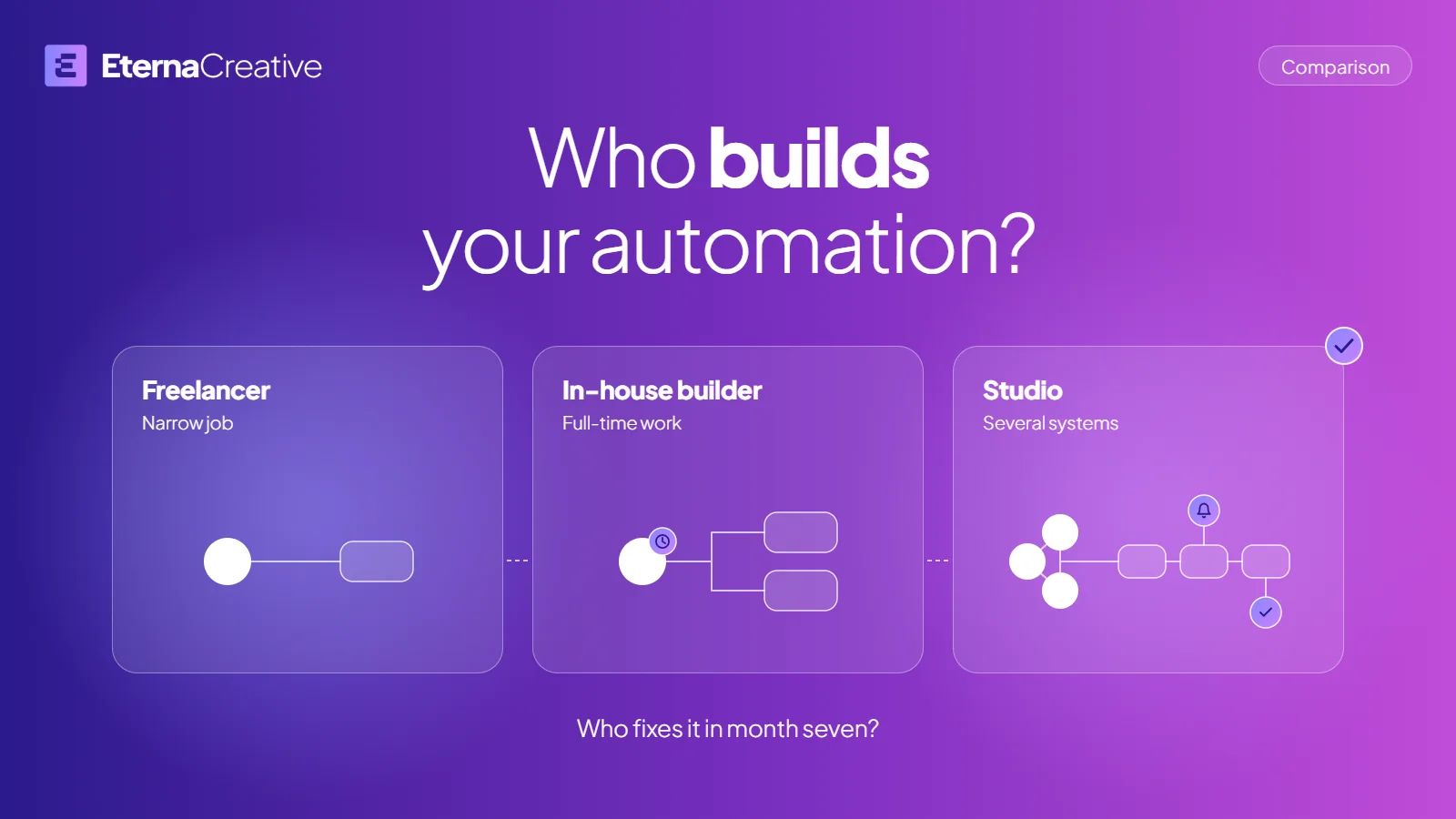
Hire a freelancer for one contained automation you can specify yourself, an in-house builder when automation is a full-time job, and a studio when you want the finished workflow, its alerts and its upkeep owned by someone else. The deciding question is who fixes it when a connected tool changes.
Most guides on this question compare price and skill. Those matter less than what happens in month seven, when a connected tool renames a field, an alert goes off, and someone has to know how the workflow works. The rest of this guide compares the three options on that, and on what you own when the work is done. If you already know which process you want to automate, how we build automations shows the way we do it.
The three options side by side
| Freelancer | In-house builder | Studio | |
|---|---|---|---|
| Best for | One contained automation you can specify yourself | Automation as continuous, full-time work | A finished workflow across several systems, with checks and upkeep |
| Who fixes it in month seven | The freelancer, if they are still available | Your employee, if they are still with you | The studio, with a maintenance package. Without one, new work is priced before it starts |
| What you manage | Scope, quality and every decision | Hiring, priorities and a full-time role | Decisions and approvals. The studio manages delivery |
| Continuity risk | One person | One person, or a small team | A team, if the agreement says who owns what |
| How you stop | You end a small project | Slower and harder: it is an employment relationship | You end the contract and keep the accounts and documentation |
| Watch out for | No second person to review the work, and no cover when they are busy | Paying a skilled person for work that does not fill the week | Paying for more breadth than the job needs |
Freelancer: right when the job is narrow
A freelancer is the right choice when the job is contained, the scope is clear, and someone on your team can review the work and make the decisions. A single automation between two tools, with no AI in the middle, is the usual example.
It is also the right choice when the budget is small and a simpler tool fits the job. A good studio tells you when a freelancer fits better. Our own rule is that if we can't resource your project properly, we'll tell you upfront.
Skip a freelancer when the automation touches money, customer data or work that runs with nobody watching, unless you have someone who can review it. A freelancer usually works alone, so there is often no second person to check the work and no cover when they are busy.
The catch is continuity. If the freelancer moves on, the knowledge of how the workflow works goes with them, unless it is written down and the accounts are yours.
In-house: right when automation is a full-time job
Hiring makes sense when automation is continuous work for at least one person, week after week. Skilled automation builders are expensive to keep busy, and for many companies the work does not fill a role. That is why companies usually hire an outside partner instead: they get the skill without a permanent salary, and they can end the contract when the work ends.
Hiring is also slower. You recruit, wait for a start date, and then wait for the person to learn your systems before the first workflow ships.
The catch is that one hire is one person. If they leave, you are in the same position as a freelancer's client. Only a large company with steady automation work tends to justify a team.
If a studio is building for you and the volume grows until it fills a role, that is the moment to hire. The studio hands over the documentation and the accounts, and your new hire starts from a working system.
Studio: right when the job crosses systems
A studio is the right choice when the automation crosses several systems, needs checks before anything reaches a customer, or has to keep running with nobody watching. You get the finished workflow, and someone else carries delivery, testing and upkeep.
The catch is paying for more breadth than the job needs. If the work is one workflow between two tools, a freelancer is usually cheaper and quicker to start.
Which tool the studio builds with matters less than the questions in this guide. The tool comparison is in n8n vs Make vs Zapier for business ops.
The question that decides it: who fixes it in month seven?
Connected tools change. A vendor renames a field, a login expires, an integration is retired, a form gets a new question. A workflow that ran for months starts to fail, and it can fail quietly. So the useful question is not who builds it, but who finds out when it breaks and who has the access and the knowledge to fix it.
Whichever option you choose, three things decide the answer:
- An alert reaches a named person when something breaks, and someone has triggered that alert on purpose to prove it works.
- Something also raises the alarm when expected work does not happen, not only when an error appears.
- The accounts, the workflow and the documentation belong to you, so you can hand the system to someone else.
These are part of every build at Eterna: error alerts to a named person, monitoring for work that did not happen, and each alert triggered on purpose before we call the work done. They sit inside the fixed price. After delivery, 2 weeks are free: 1 week of testing and 1 week of fixes. After that, maintenance is priced separately, and we always offer it, because tools and integrations change over time. How we handle AI inside an automation is on How we build with AI.
What to ask before you hire anyone
Ask each option, including a studio, these six questions:
- Who owns the accounts, the workflow and the documentation when the work is done?
- Who receives an alert when something breaks, and has that alert been tested?
- What does it cost to change something later, and how is that work priced?
- Can I see something similar that is still running?
- How do I stop, and what do I receive when I do?
- Which outside tools does the build depend on, and will I get the list?
A vague answer to the first two is the warning sign. If nobody can say who is alerted, nobody is watching.
A hybrid is often the practical answer
A common pattern is a studio build followed by a small freelance or in-house role for later changes. It works when the handover is real: the accounts are in your name, the workflow is documented, and the list of outside tools comes with it. It fails when the builder keeps the accounts and the knowledge.
What it costs
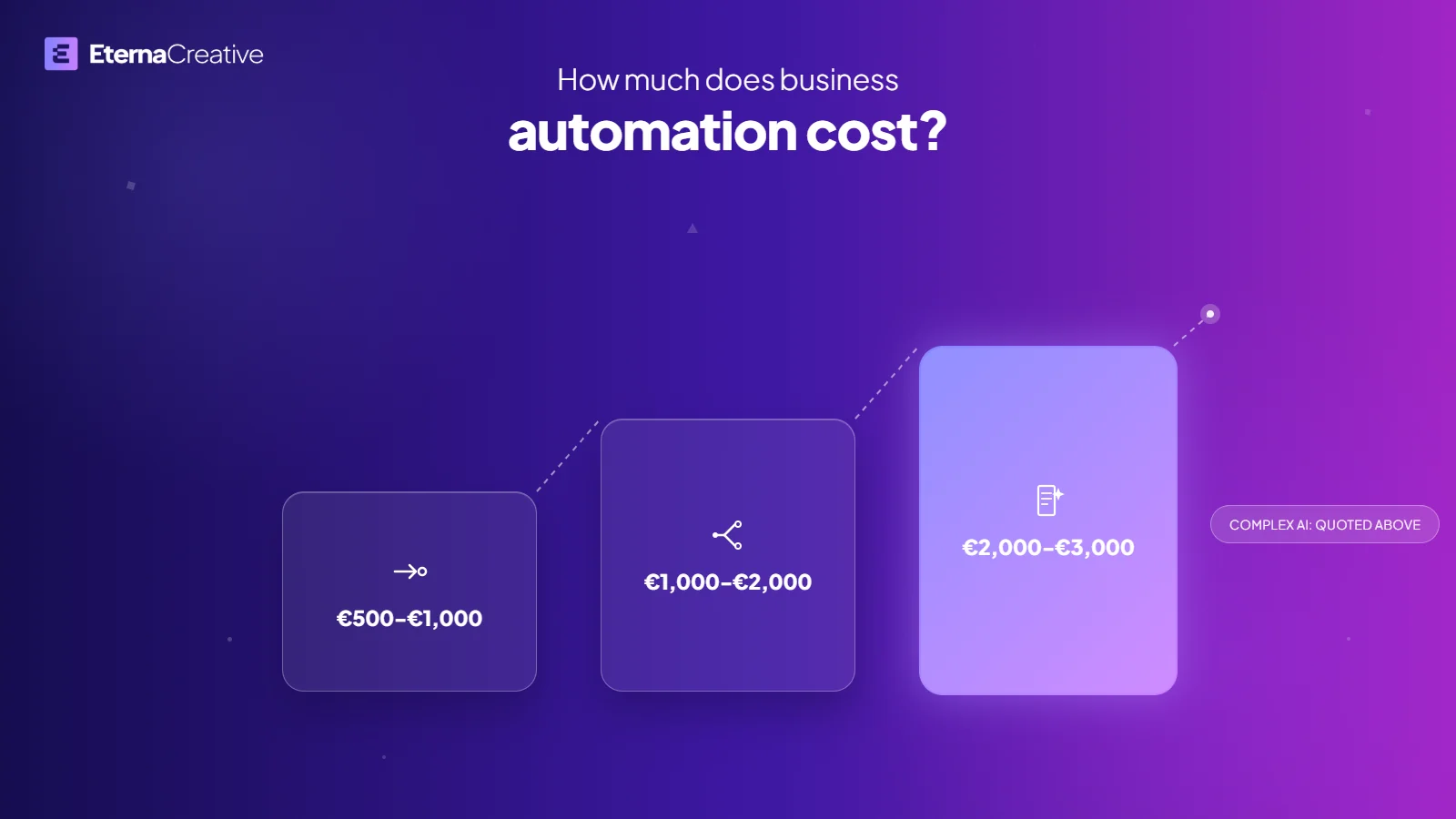
Third-party guides quote salaries and hourly rates that change by country and by year, so this guide does not repeat them. Our own prices are public. One automation costs €500 to €3,000 in three ranges, complex AI is quoted above that, and the price is fixed for the scope we agree. The cost guide shows what puts an automation in each range.
Proof
Lead Agents, a client of ours, runs 12 live n8n systems that we built. The automations save about 15 hours of ops work every week. See the Lead Agents case study. Your number will be different; the point is to measure it before and after.
The work is done by Marko and a small senior team. There is no junior bench and no account-manager relay. If we can't resource your project properly, we'll tell you upfront.
FAQ
Is an AI automation studio the same as an agency?
Close, but not the same. An agency usually sells a team's time. A studio like ours delivers a finished workflow at a fixed price for the scope we agree, with the alerts and checks inside that price.
Is a freelancer cheaper?
Usually the day rate is lower. What you carry instead is management: you write the scope, review the work and find cover when they are busy. For a contained job that trade is good. For work across several systems it tends to cost more than it saves.
When should a small company hire in-house?
When automation is steady, full-time work for one person, and you can keep that person busy and supported. Many mid-sized companies never reach that point, which is why they usually hire a partner instead.
Can a studio hand the system over to my team?
Yes. You own the code, workflows, accounts and documentation, and you receive the list of outside tools the build depends on. That is what makes a later handover possible.
Who fixes the automation when a connected tool changes?
The alert goes to a named person. With a maintenance package, we handle the fix. Without one, the fix is quoted as new work before we start.
What does an automation cost?
One automation costs €500 to €3,000, set by how complex it is, at a fixed price for the scope we agree. Complex AI is quoted above that. The cost guide has the detail.
Verdict
Pick a freelancer for one contained job you can specify and review yourself. Pick an in-house builder when automation is full-time work you can keep filled. Pick a studio when the work crosses systems, has to run without anyone watching, and you want the alerts, the checks and the upkeep owned by someone else. Whichever you choose, settle who fixes it in month seven before you sign.
If you want a second opinion on which fits your process, book a free audit call and we will tell you on the call. To see how we build, start with the automation service page.