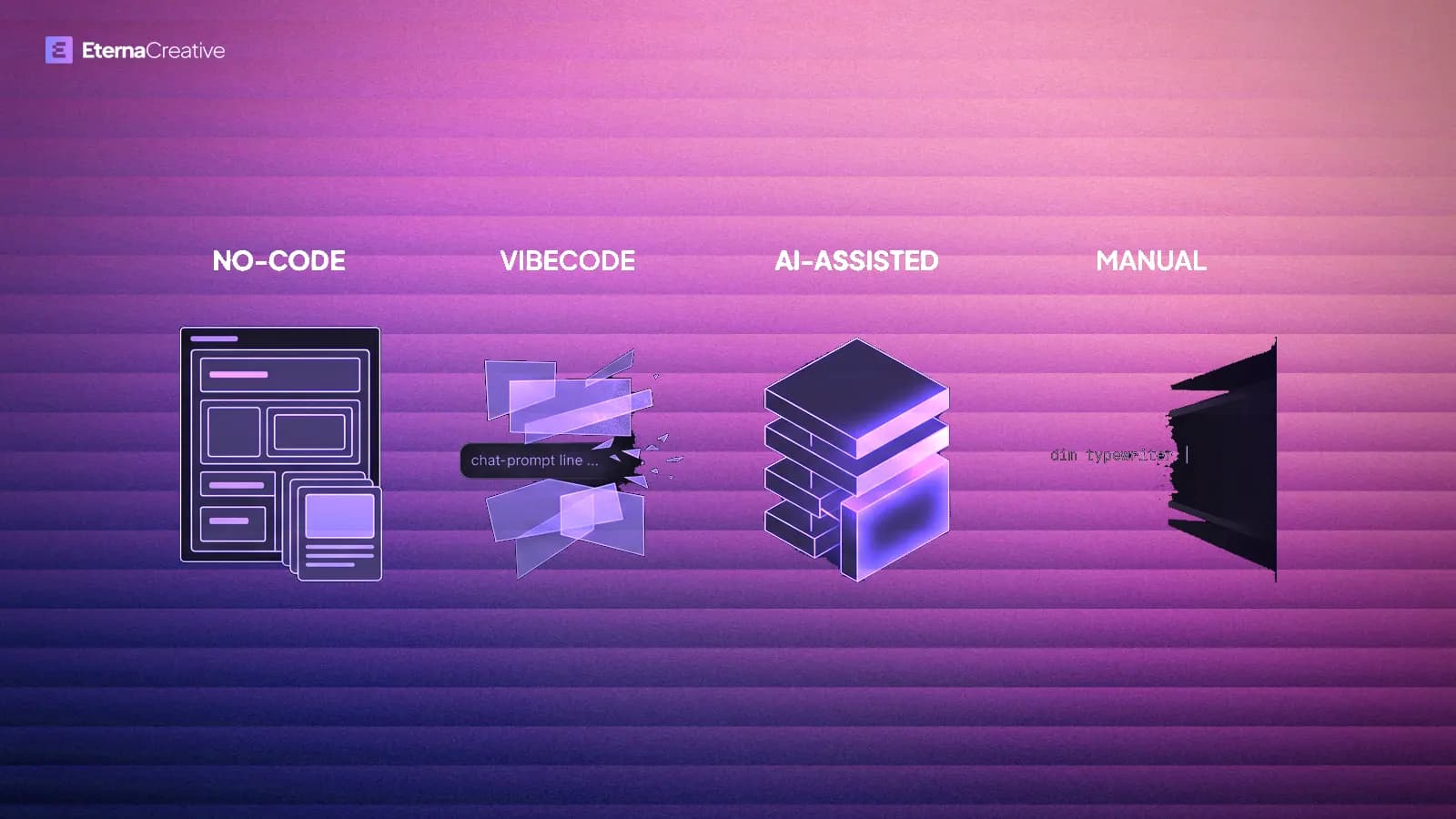
No-code and vibecode are for prototypes. If you will keep the product, build AI-assisted custom code: Cursor or Claude Code agents, a real Git repo, tests, and review. A team typing every line by hand is the old bill. Time-to-first-version is no longer a huge gap. What you own in twelve months is.
TL;DR
- No-code (Bubble and similar): visual builders. Fine for a first version when nobody on the team will touch a repo. You own the app config, not the runtime.
- Vibecode: describe the app in English and ship what the model wrote, often without reading it. Fine for a throwaway demo. A 2026 audit of Lovable-class apps found most shipped with Row Level Security off.
- AI-assisted custom (Cursor / Claude Code, with rules): vibe-speed plus engineering. This is the default if the product has to live. Without tests and review it collapses back into vibecode.
- Manual custom: engineers, no agents. Still exists. Slower and more expensive for the same thin scope. We do not sell it.
- If you are unsure, start the lightest prototype that teaches you something - then put the thing you will keep on an owned repo.
Four paths, not two
The old chooser was "Bubble or custom." That hid two different ways of writing code, and it treated no-code as the only fast option. In 2026 you are picking among four jobs.
No-code is a visual builder. You configure components and workflows. Bubble, Glide, Adalo, Retool. You do not export a normal codebase.
Vibecode is the word Andrej Karpathy coined in February 2025: you describe intent in natural language and let the model write the software, often without reading every line. Lovable, Bolt, v0, or Cursor used as a toy. Some of those tools can export React. Many demos never leave the vendor.
AI-assisted custom is agents on a real repo: Cursor, Claude Code, similar. The agents plan, write, and test. A human still owns architecture, review, and anything that touches money or customer data. Rules files, CI, and code review are the difference between this path and vibecode.
Manual custom is a team writing production software without coding agents. It is how most studios billed five years ago. It is not how we build.
If nobody can explain the offer in one sentence, you do not need a stack argument yet. You need a thinner product - or a conversion site instead of an app.
No-code vs vibecode vs AI-assisted vs manual
Studio quotes below are 2026 market estimates for a thin scope (auth, CRUD, one workflow, one dashboard). They are order of magnitude, not an invoice. Eterna application work starts from €4.000. A focused first version is often 4-6 weeks. Exact scope lands on the call.
| No-code | Vibecode | AI-assisted custom | Manual custom | |
|---|---|---|---|---|
| Best first use | Prototype when nobody will maintain a repo | Throwaway demo this week | Product you will keep | Legacy teams; we do not sell this |
| Time to a first version (estimate) | About 2-4 weeks DIY; some tables say 14-21 days hired | Hours to a couple of days for a demo | Days to a few weeks; often overlaps no-code for a thin scope | Often 8-16 weeks well-scoped; 3-6 months for a broader SaaS |
| Market quotes (2026 estimate) | About $5,000-$15,000 for a Bubble MVP | Hours DIY; paid "finish this" work often $1,000-$15,000 | Wide: some thin MVPs quoted $3,000-$7,000; broader AI-powered builds $20,000-$45,000+ | About $25,000-$60,000+ for mid-complexity SaaS |
| What you own | Config and data. Not the runtime. No real code export. | Sometimes exported React. Often trapped on the vendor. | The Git repo. You still pay hosting and the model vendor. | The repo, if they actually give it to you |
| Where it breaks | Workload units, plugins, SEO, one Bubble specialist | Auth, secrets, nobody can change the chat | No rules/tests - then it is vibecode | Cost, speed, silent rewrites |
| Skip if | You already know you must hire engineers next year | Customers will log in with real data | You have zero engineering judgment in the room | You are still finding out if anyone wants this |
Those week ranges disagree with each other across agency blogs. Treat them as estimates, not a benchmark. Full bands: Application, migration / rescue, and the cost calculator for apps, automations, and websites.
No-code
Best for a first version when the team will not live in Git. CRUD, permissions, a workflow, a dashboard. A non-technical operator can still move faster here than they can in Cursor, if nobody is helping them engineer.
The trade-off is the runtime. Bubble bills on Workload Units - starter plans in the tens of dollars per month, then overage. You can export data. You cannot pick up the box and leave. Workflows get re-implemented. "We outgrew Bubble" usually means performance, WU cost, SEO, mobile, or the one person who knew the canvas left.
Keep Bubble if it is already live and healthy. Do not start a new product there because it used to be the only fast path.
Vibecode
Best for a demo you can throw away. Hours to a clickable thing. Useful when you need to see the idea, not when a customer stores a password.
The trade-off is production. One 2026 audit of Lovable apps reported about 70% shipped with Row Level Security disabled, and on the order of 170 of 1,645 scanned apps had a fully exposed database. Public write-ups of inverted access control on that class of app put tens of thousands of users across many apps in the blast radius. Secrets in the frontend. Diffs nobody can review. "Nobody can change it except the original chat."
If the Cursor window is the company, you do not have a product yet. You have a prototype that still needs an owner, tests, and a repo.
AI-assisted custom
Best for a product people will log into next quarter and next year. Agents write most of the boring code. You keep a Git repo, CI, review, and rules (AGENTS.md, design constraints, humans on money and customer comms). That is vibecode speed with engineering steps.
This is our default for new application work - Cursor and Claude Code agents, not a room of people typing every line. A focused first version is still often 4-6 weeks from €4.000, because scope and judgment are the bottleneck, not keystrokes.
The trade-off is discipline. Skip the rules and the tests and you are back on the vibecode path with a fancier IDE. You also pay hosting, database, auth, and monitoring separately. Bubble's all-in bill is simpler. The repo is the point.
Agency blogs in 2026 talk about 40-60% less coding time on routine work, and agents on most of the grind, with humans on architecture. That is a trend, not a census. We are not waiting for a census to stop selling manual custom.
Manual custom
Best for almost nobody buying a first version in 2026. If a studio still quotes 3-6 months and $25,000-$60,000+ for a mid-complexity SaaS and does not mention agents, you are paying 2022 prices for 2022 speed.
The trade-off they will not say: the work is slower, the work still gets rewritten by people who were not in the room, and the productivity from agents does not reach you. Public data does not prove manual-only teams are already a minority. It does not matter for how we staff. We do not sell that bill.
Is no-code still much faster?
Not in a way you should bet the company on. One 2026 table still puts a hired Bubble MVP at 14-21 days and Next.js plus Cursor at 14-30 days for a launchable thin scope - overlapping weeks, not a different sport. Vibecode demos still win on hours. Manual teams still lose on months.
Other posts still claim no-code MVPs in 2-4 weeks and "AI-powered" MVPs in many months. Those tables mix a toy Bubble app with a wide custom build. Same-scope, the speed gap has shrunk. The ownership gap has not.
If you have no engineering help at all, Bubble can still be the shortest path to something you can click. If you are hiring a studio that already runs agents, do not pick no-code "for speed." Pick it only if you want the visual runtime on purpose.
What you own, and how you leave
Bubble: you own configuration and data. Migration is a rebuild of the logic. Market estimates for Bubble to custom in 2026 run about 4-20 weeks and about $8,000-$60,000+ depending on complexity. AI-assisted work can cut that versus a 2023 manual rewrite. Label those as estimates.
Vibecode platforms: some export React. Rescue write-ups quote audits in the low thousands, stabilization in the tens of thousands, and full rebuilds for badly grown apps that can reach six figures. Do not wait for that invoice. Put the revenue path on a repo while the demo is still small.
Cursor / Claude Code on Git: you own the code. You still depend on the model vendor and on hosting. That is a vendor you can change without rebuilding the product from a canvas.
We rebuilt our own site from Bubble to Next.js in four weeks. Page speed went from below 50 to around 98. The site was the bottleneck - identity and conversion - not a missing members area. That story is the Bubble to Next.js rebuild. A marketing site hitting a platform ceiling is a good reason to leave. A working internal Bubble app with no pain is not.
When hybrid is smart
You do not have to rewrite everything on Tuesday.
- Bubble plus Xano or Supabase when data and logic need to leave the canvas first
- A custom marketing site in front of a no-code or vibecode app when SEO is the hole
- A vibecode demo, then an AI-assisted rewrite of auth, payments, and the money path - keep the UI if it is honest
Hybrid is smart with a sunset date. Two systems with no owner is how you pay twice forever. See how rescue works if the prototype already escaped the lab.
Mistakes that waste the first month
Paying a manual custom team to sound serious before there are users. You will wait months to learn what a two-week prototype would have taught you.
Staying on no-code with no exit criteria, then blaming Bubble. Write the trigger now: WU bill, SEO, hiring, or "we cannot change this without one specialist."
Shipping the vibecode demo as the product. Customers in, Row Level Security off, nobody owns the chat. That is not an MVP. That is an incident waiting for a scanner.
Calling Cursor "custom" with no repo, no tests, and no review. That is vibecode with a better theme.
Rebuilding everything instead of the revenue path. Auth, payments, and the job people pay for first. The rest can wait.
Building an application when you needed a page that books a call. If they do not need to come back tomorrow, read the website vs application vs automation chooser before you pick a stack.
FAQ
No-code vs custom code vs vibecode vs AI-assisted - which should I pick? Prototype on no-code or vibecode if you must. If you will keep the product, pick AI-assisted custom: agents, a repo, tests, review. Do not pay a manual team for a first version.
Is vibe coding the same as Cursor? No. Vibecode means you do not read the output. Cursor or Claude Code with rules, CI, and a human on the diff is a different job. Same tools can do both. The discipline is the product.
Is no-code still faster? For a non-technical person with no help, sometimes. For a hired build on a thin scope, 2026 tables often put Bubble and AI-assisted custom in overlapping weeks. Ownership is the gap that remains.
Can I export my Bubble app? Data, yes. The runtime and the workflows, no. Leaving is a rebuild of the logic, not a download.
Do you still build Bubble? We migrate and rescue Bubble and vibecode when that is the honest job. New application work defaults to AI-assisted custom. Existing Bubble that is healthy can stay until a trigger hits.
Why are your starting prices below some US quotes? Those $20,000-$60,000 figures are 2026 market estimates, not our bands. Application work starts from €4.000. Larger builds get a free Blueprint before you commit. Exact scope lands on the call.
How to pick without locking the stack
If it is a demo, vibecode or no-code is enough. If customers will log in with real data, put it on a repo and run agents with rules. If a studio quotes you months and never mentions Cursor or Claude Code, you are buying the old bill.
Book a free strategy call if you want a second opinion on stack and scope - including when staying on Bubble is smarter than a rebuild. Rough bands: the cost calculator for apps, automations, and websites. Stuck already: see how rescue works.