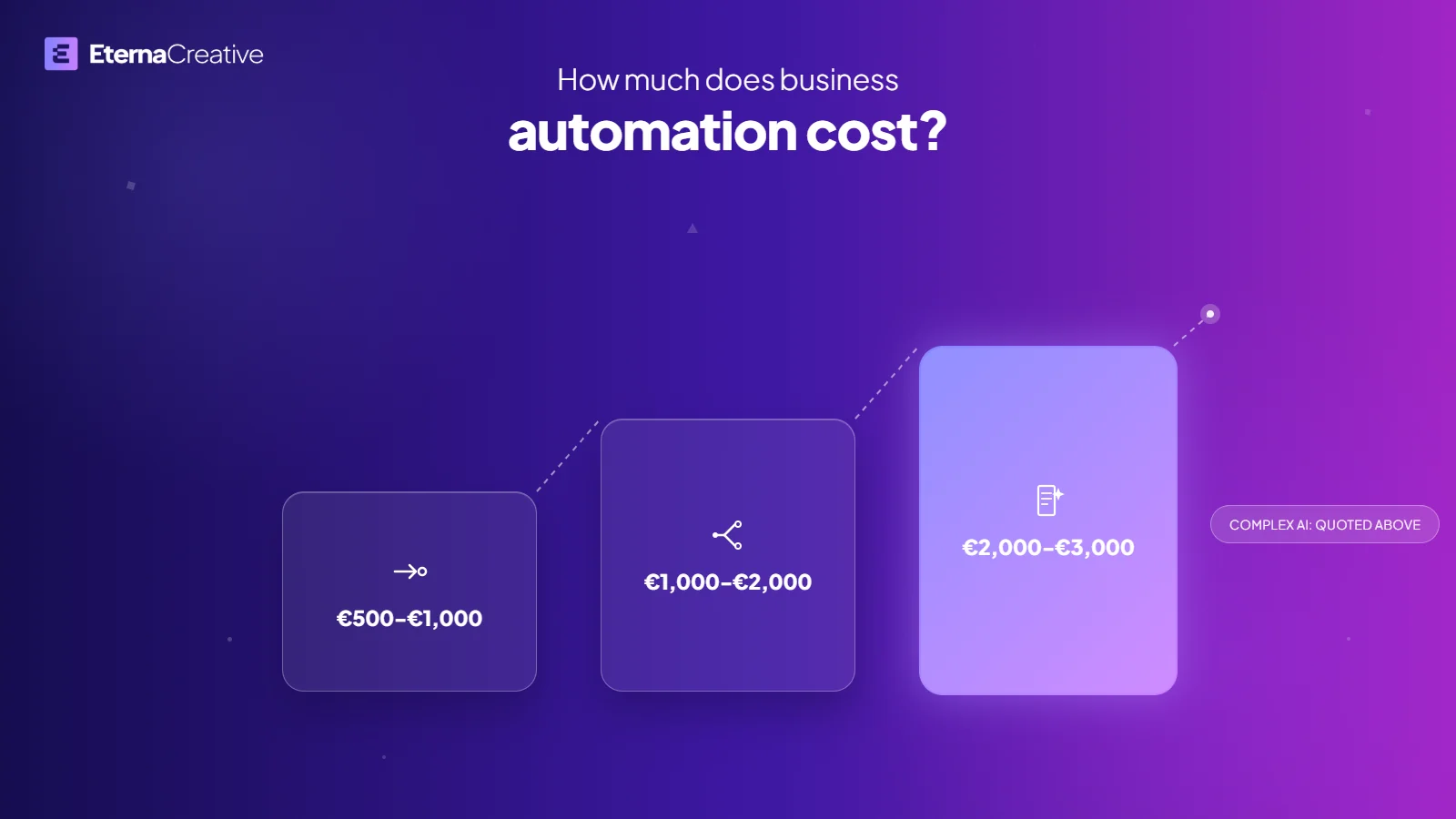
A single freight document automation costs from 500 euros at Eterna, in three ranges up to 3,000 euros by complexity. Teams that need a steady stream take Freight Operations from 800 euros a month. The price moves with document variety, scan quality, and how many systems the data has to reach.
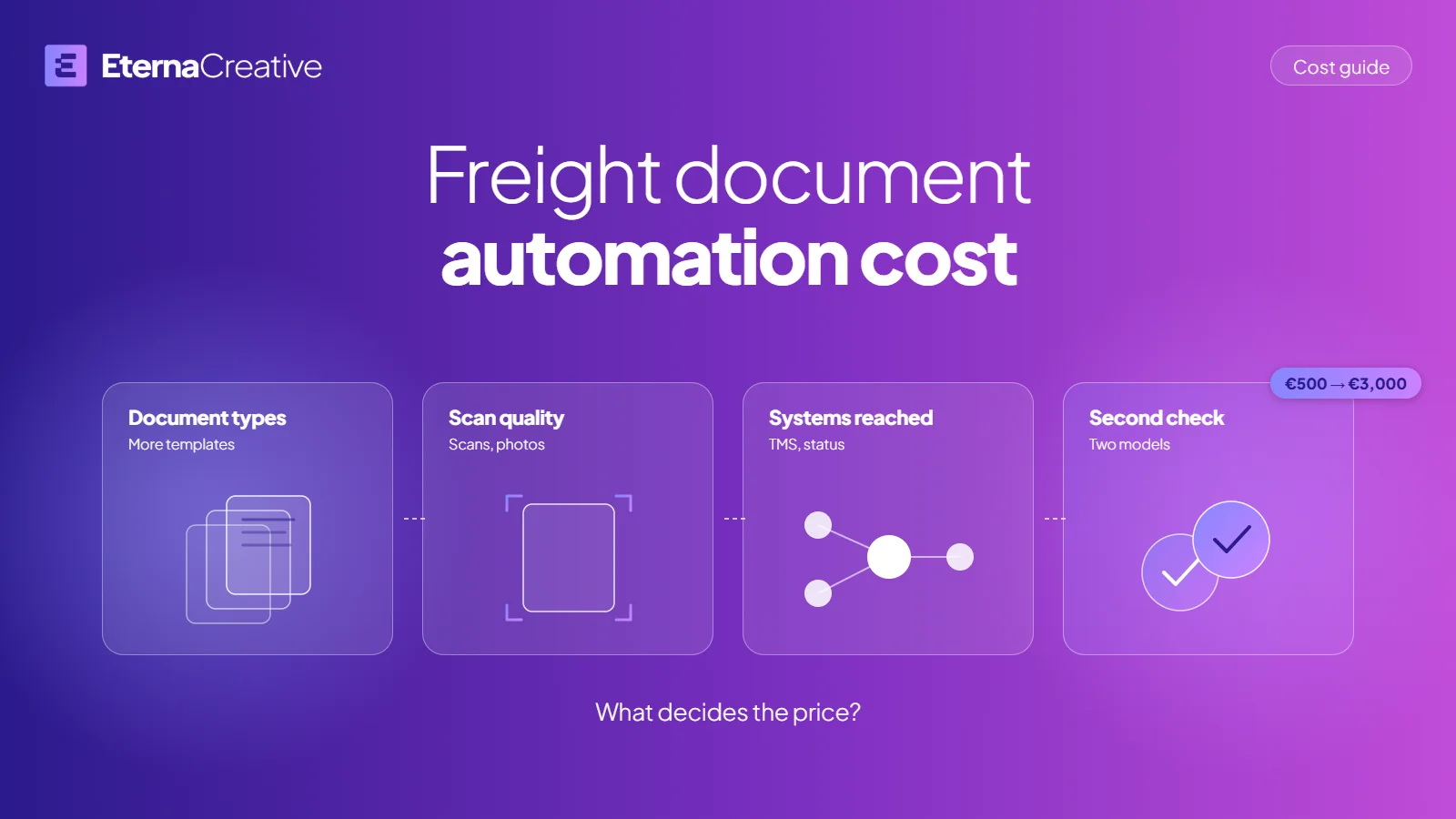
Most forwarders and brokers already know the manual side of this. Someone opens a rate confirmation, reads it, and retypes it into the TMS, and the pattern repeats on every load. What decides the price is not that pattern, but how many document types it covers, how clean the scans are, and how many systems have to agree before a load is saved.
The three price ranges
| Price range | What it usually looks like | Examples |
|---|---|---|
| €500 to €1,000 | One document type, one system to update, simple rules, no AI | A single rate confirmation template into one TMS field set |
| €1,000 to €2,000 | Several document types or broker templates, branching rules, some manual review kept in the loop | Rate confirmations from 3 broker templates, both scanned and digital |
| €2,000 to €3,000 | AI reads varied documents, checks its own output, and updates several systems | Extraction with a second model checking the first, writing to the TMS and a status update |
| Above €3,000 | Complex AI across many document types, high volume, or several connected systems | Quoted after the audit call |
What moves an automation into a higher range
Document variety. One broker's template in one format costs less than the same document arriving as five templates, in English and Spanish, some scanned and some digital. Every new template is a case the automation has to handle correctly.
Scan quality. A digital document is direct text. A scanned or photographed one has to be read first, and a bad scan, a skewed photo, or a stamp over the numbers makes that harder. We tested 14 AI models on freight rate confirmations, and the strongest scanned-document model still failed on both digital documents we ran it against: scanned and digital work is not the same job, and pricing has to account for both if a forwarder needs both.
How many systems the data has to reach. Writing one field into one TMS is simpler than updating the TMS, sending a status message, and flagging an exception for a dispatcher, all from the same document.
Whether a second check runs before anything is saved. A single model reading a document is cheaper to build than two models reading it independently and a flagged disagreement going to a person. The second version costs more to build, and it is the version we run in our own product.
What Zonik built, and what it costs
Zonik AI, a logistics product we co-founded, is where we tested this before pricing it. The test ran 14 AI models on real US broker rate confirmations, 3 scanned and 2 digital, from 3 broker templates. No single model was reliable on its own, and the winning models on scanned documents were not the winning models on digital ones.
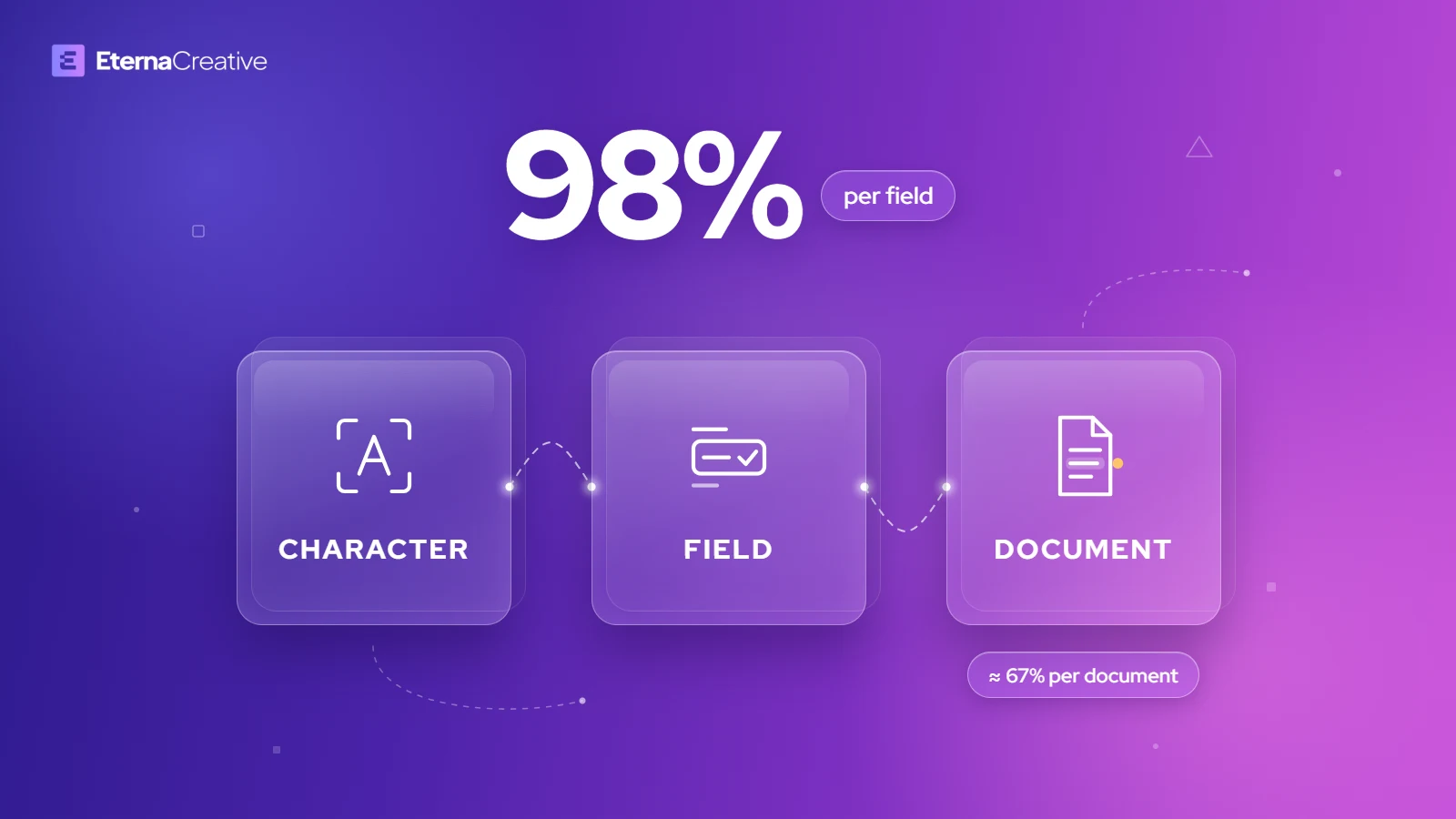
Since September 18, 2026, Zonik runs two models on every rate confirmation its first users upload: one pair for scanned documents, one pair for digital ones. The two answers are compared field by field, dates, times, rate, weight and miles have to match exactly, and a disagreement is flagged for the dispatcher to check before the load is saved.
As a projection from that test, running the two scanned-document winners together costs roughly $3,300 to $5,100 per million scanned documents, about 72% less than a single call to gpt-4o. It is a projection, not a measured cost of the live check, and no production savings claim is made for the digital path. No freight client result exists yet: this is what our own product taught us about pricing the same kind of build for a client.
What's included in the price
Every automation we build, single or inside a program, ships with error alerts to a named person, monitoring for work that did not happen, and each alert triggered on purpose before we call it done. These sit inside the fixed price, not billed separately. After delivery, 2 weeks are free: 1 week of testing and 1 week of fixes. After that, ongoing maintenance and support is scoped on the call, because tools and integrations change over time.
One-off automations, or the program
A single automation, from 500 euros, is the way to start: pick the highest-friction document, price it, and see it work before committing to more.
Freight Operations is the option for a forwarder or broker who already knows the document, status and exception work will keep growing. It runs from 800 euros a month for 3 automations a year, 1,500 euros for 6, or 2,500 euros for 12, with build and maintenance included in the price. If the program is not working for you, written notice before month 3 ends stops it, no reason required, you keep everything built, and at least one automation will be live inside that window.
Why this is worth budgeting for
Only 17% of companies in transportation management are fully automated, and over a third are still mostly manual (Descartes TMS Benchmark Survey, 2025). The same survey found 96% of companies already using generative AI somewhere, and the top use is data entry. Most forwarders have not digitized the paperwork side: only 23% have digitized over 75% of their processes, and under 40% use a forwarding management system at all (Magaya, State of Digitization in Freight Forwarding, 2025). The document that still moves by hand, a rate confirmation, a status update, an eCMR, is the common gap: the electronic consignment note is used on less than 1% of the roughly 280 million international road transport operations a year (IRU, 2025).
FAQ
How much does a freight document automation cost?
From 500 euros for the simplest, one document type into one system, up to 3,000 euros for AI reading varied documents with a check before anything is saved. Complex builds across many document types or high volume are quoted after the audit call.
What makes rate confirmation automation more expensive than other documents?
Broker templates vary, some come in as clean digital text and others as scans or photos, and a rate confirmation touches several fields that all have to be right before a load is booked. Each of those adds a case the automation has to handle.
Is a program cheaper than paying for automations one at a time?
Not per automation. Freight Operations costs more per automation than paying one-off, because it also buys the standing relationship: the same partner building and maintaining every automation, with an exit if it stops working for you. It's the right fit once the document and exception work is a steady stream, not a one-time fix.
Does AI reading documents replace the dispatcher?
No. In the check we run in our own product, two models read the same document, and a dispatcher reviews and confirms before the load is saved. A disagreement between the two is flagged for a person, not resolved automatically.
What's included in the price, and what costs extra?
Error alerts, monitoring for work that did not happen, and a triggered test of every alert are inside the fixed price. Two weeks after delivery are free, one for testing and one for fixes. After that, ongoing maintenance and support is scoped on the call.
Can I start with one automation and add more later?
Yes. Many clients start with a single automation from 500 euros, and move to the program once the volume of document and exception work justifies a standing partner.
The verdict
A single freight document automation costs 500 to 3,000 euros, set by how many document types it covers, how clean the scans are, and how many systems it has to update. A program is worth it once that work is a steady stream, not a one-time fix. Start with the document that costs you the most time by hand, and book a free audit call to find out where it lands. To see how we build, start with Freight Operations.