TL;DR
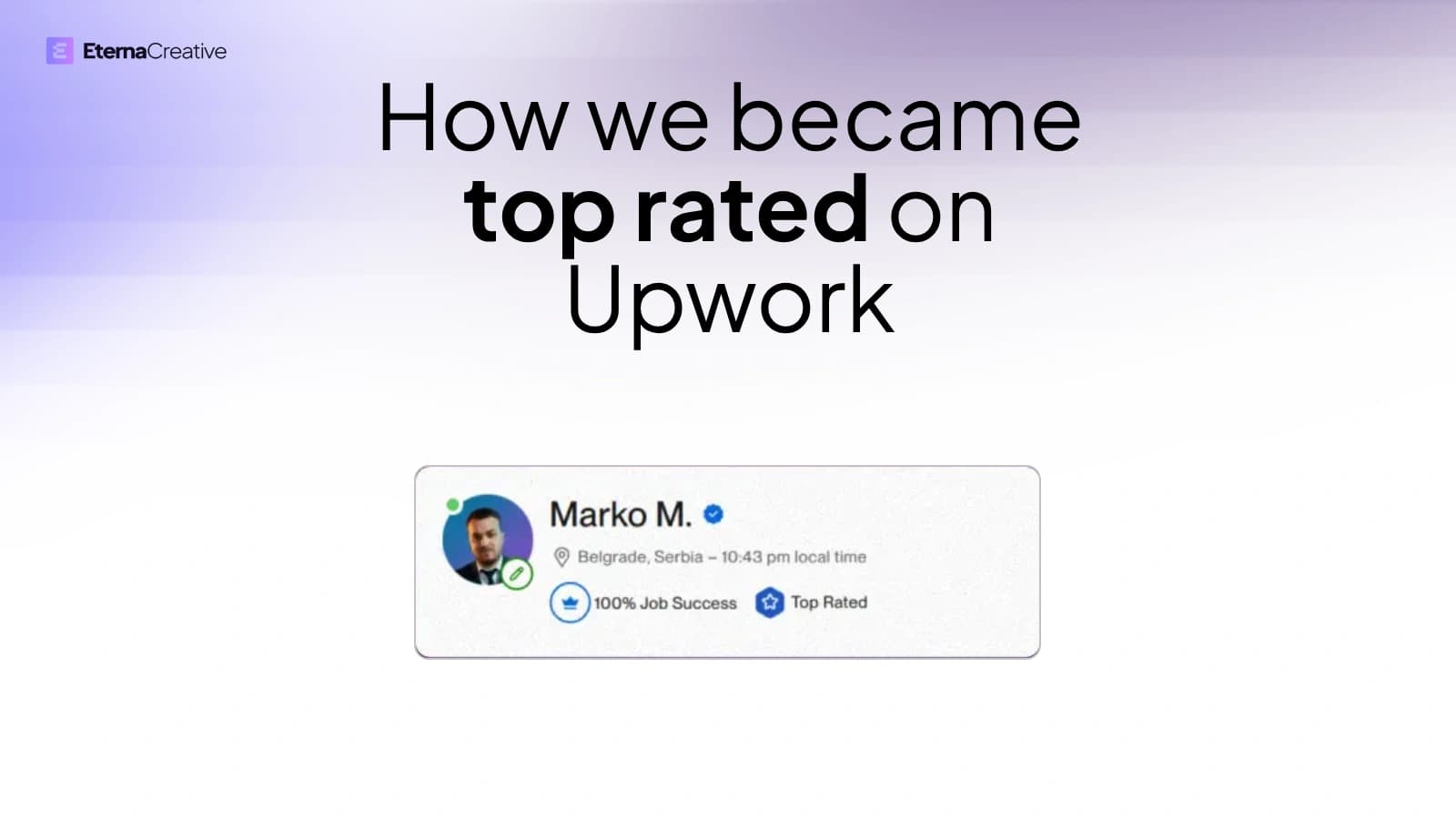
- Achieved Top Rated status on Upwork with 100% Job Success Score and 5-star ratings
- Won a major project against a 50+ person studio through better approach and founder-level guidance
- Upwork isn't dead - you just need to stand out with quality delivery and strategic positioning
- Free Blueprint upfront proves capability before clients spend a dollar
"Don't waste your time on Upwork"
That's what everyone told me. "The platform is dead. It's all a race to the bottom. You'll compete with $5/hour developers from countries with low costs. Clients just want cheap, not quality." I had the same feeling and for months, I avoided Upwork completely. Then my friend - who runs a 20+ person SEO firm and crushes it on Upwork - told me I was being stupid. "You're leaving money on the table because you're scared of competition. Just try it." So I did.
Two months later: Top Rated badge, 100% Job Success Score, 5-star rating. And we just won a major project (announcement coming soon) against a 50+ person studio. Here's my take on what actually works on Upwork in 2025.The real problem isn't Upwork - it's your approach
Most developers treat Upwork like a job board. They spray generic proposals hoping something sticks. That's why they fail. Here's what we did differently:
1. Perfect your profile (it's your first pitch)
Your profile isn't a resume. It's a sales page. We positioned ourselves clearly:
- Bubble.io developer | 20+ apps built | MVP | SaaS | Fundable products
- Higher range rate (not competing on price)
- Portfolio showing real projects with context
- Clear specialization (no-code for startups)
2. Choose projects, don't chase them
Better to skip a project than bang your head against a nightmare client.
Red flags we watch for:- Vague requirements with "just a simple app" language
- Budget under $1K for complex scope
- "Looking for the cheapest option" in description
- Multiple revisions or scope changes in previous feedback
- Demanding tone or unrealistic timeline expectations
- Clear project description with thought-through requirements
- Realistic budget for scope described
- Questions that show they understand development isn't magic
- Previous jobs with good feedback given
- Professional communication style
We turn down 70% of invitations. The 30% we take convert at high rates because they're already qualified.
3. Pitch concrete value, not generic skills
Every developer says "I'm experienced in Bubble" or "I can build your app." That's noise.
Our proposals:- Start with the client's specific pain point or challenge
- Show we understand their business context, not just tech requirements
- Reference similar projects we've built with outcomes
- Position as strategic partner, not just hands
This demonstrates industry leadership, not just technical capability.
4. Deliver world-class experience from start to finish
Quality delivery is obvious. But client process matters just as much. Our process:
- Start every project with free Blueprint (hero screen design, user flow map, technical roadmap, strategic analysis)
- Weekly demo calls showing progress (no surprises at delivery)
- Notion client portal for all documentation and communication
- Two weeks post-launch support included
- Clear scope management (changes documented and approved)
We're not just delivering apps - we're delivering confidence.
5. Prove value upfront (risk reversal)
Most freelancers: "Pay me and I'll build it." Us: "Let me prove capability first, completely free."
The Blueprint costs us ~4-6 hours of work. But it:
- Eliminates tire-kickers (they won't invest time if not serious)
- Proves our strategic thinking before they spend budget
- Catches scope issues before development starts
- Builds trust that we actually know what we're doing
Why we beat the 50+ person studio
Last month, we won a major 300+ hours project against an established studio with 50+ engineers.
They pitched: "We have a large team, proven process, extensive portfolio." We pitched: "I'm a founder myself. I've built 4 startups and 20+ apps. I understand the pressure you're under - needing to validate quickly without blowing your runway. Here's exactly what I'd build first and why."They chose us because:
- Founder-level strategic thinking (not junior devs following orders)
- Direct communication with the person actually building (no project manager middleman)
- Better approach to their specific problem (we understood their business, not just their tech requirements)
- Faster decision-making and iteration (no corporate bureaucracy)
- We just kill at designing products, and client saw that upfront
Upwork isn't dead - it's just selective
The platform works if you:
- Position yourself clearly with specific expertise
- Qualify clients before proposing (say no to red flags)
- Lead with strategy and value, not just technical skills
- Deliver world-class experience consistently
- Use upfront value to prove capability
- Generic profiles trying to do everything
- Racing to bottom on price
- Copy-paste AI proposals
- Taking every project to "build reviews"
- Competing on price instead of quality
We're doubling down on Upwork in coming months as one of our key channels. Not because the platform changed. Because we figured out how to stand out.
---
Ready to work with a Top Rated no-code product studio? Book your free Blueprint session and let's see if we're a fit.
Keep exploring
See how that same standard shows up in our portfolio and Bubble Bronze Partner milestone. Founders comparing build paths should read freelancer vs studio then book a free Blueprint.